
Steve Goldstein
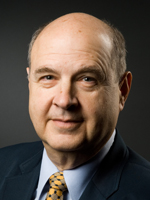
Steven N. Goldstein retired from the National Science Foundation in 2003. He joined NSF in 1989 as a Program Director in the Computer and Information Sciences and Engineering (CISE) Directorate's networking division. Before joining NSF, he was a MITRE Corporation contractor to NASA, helping to establish the NASA Science Network, NASA's entry into TCP/IP research networking.
At NSF, Dr. Goldstein quickly gravitated to the international arena and launched the International Connections Management (ICM) project, awarded to Sprint, in 1991. Over the next six years, ICM implemented the connection of academic networks from about 25 countries to the NSFnet and to its advanced networking successor, the vBNS. ICM made the first academic connection with Russia in 1994, followed by two with China in 1995. The last country to be connected was Mongolia in early 1996. Dr. Goldstein also managed a series of awards to the Network Startup Resource Center, NSRC, (http://www.nsrc.org), which assisted grassroots organizations in many under-networked countries to establish Internet connectivity. NSRC has been a major player in training network operators in sub-Saharan Africa and in supporting SSA networks in the formation of the African Network Operators Group (AFNOG).
By the mid-1990's, Dr. Goldstein had shifted his focus to even more advanced international networking under the High Performance International Internet Services project (HPIIS). Under HPIIS, a high-performance link with Russia was implemented, first as MirNet, and in a later more advanced version, as NaukaNet. He served as the U.S. representative to the G7 Global Information Society initiative titled "Global Interoperability of Broadband Networks" (GIBN). To further the GIBN goals, he made an award to implement the international networking meet-point, STAR TAP (http://www.startap.net) and, as the technology progressed, its transition to the optical-networking meet-point, StarLight (http://www.startap.net/starlight/).
Dr. Goldstein helped to guide the high-impact HPIIS follow-on to NaukaNet, the Global Ring for Advanced Application Development (GLORIAD, http://www.gloriad.org/). GLORIAD has constructed a dedicated lightwave round-the-world link, initially connecting the U.S., Russia and China. Recently, Canada, Netherlands and Korea as well as the Nordic backbone association, NORDUnet, joined the enterprise. He was elected as a Foreign Member of the Russian Academy of Sciences in May 2006.
In his final tour at NSF's Engineering Directorate, Dr. Goldstein developed the strategy for the Information Technology subsystems for the Network for Earthquake Engineering Simulation, NEES (http://www.nees.org).
Steven Goldstein was selected by the 2006 Nominating Committee to serve as a Board Member. His current term will run from the end of the 2006 annual meeting through the conclusion of the 2009 annual meeting.