
Internationalized Domain Names
News
May 2026 – ICANN Seeks Input on Additional Reference Label Generation Rules and Related Updates
February 2026 – ICANN Publishes Reputation Block List Analysis for IDNs Q3 2023–Q4 2025
November 2025 – ICANN Seeks input on String Similarity Evaluation Guidelines for New gTLD Program: 2026 Round

All Announcements
Overview
Internationalized Domain Names (IDNs) enable people around the world to use domain names in local languages and scripts. IDNs are formed using characters from different scripts, such as Arabic, Chinese, Cyrillic or Devanagari. These are encoded by the Unicode standard and used as allowed by relevant IDN protocols. Examples of IDNs usage can be found here: IDNs in Action Globally.
ICANN has instituted the IDN Program to assist in the development and promotion of a multilingual Internet using IDNs. The program is primarily focused on the planning and implementation of IDN top-level domains (TLDs), including IDN country code TLDs and generic TLDs. The IDN Program also supports projects geared towards effective use of IDNs at the second-level of the Domain Name System, as guided by the community.
IDN Program Projects
Top-Level Domain Projects:

Root Zone Label Generation Rules (RZ-LGR)
A community driven project aiming to define conservative mechanisms for introducing IDN TLDs into the Internet's Root Zone in a stable and secure manner.

IDN Variant TLD Implementation
A project to support the development of policy and procedures for implementing IDN variant TLDs.
String Similarity Evaluation Data
ICANN organization collected string similarity data from script experts to be used in the evaluation tool to support the independent String Similarity Evaluation (SSE) Panel. The String Similarity Evaluation Data for the New gTLD: Next Round is being published for public comment to seek community feedback.

LGR Tool
An application that enables users to create, use and manage IDN tables in the formal, machine-readable format, called Label Generation Rules.

IDN ccTLD Fast Track Process
Fast track process created by Internet community for evaluation of top-level IDN labels representing countries and territories.
Second-Level Domain Projects:

IDN Implementation Guidelines
Recommended practices developed through a community-led process to reduce user confusion and promote consistent use of IDNs for registries implementing IDNs at the second level.

Second-level LGR References
Reference second level LGRs, reviewed by experts and community, being provided to assist registries offering IDNs during Pre-Delegation Testing and the Registry Service Evaluation Process.
Learn More
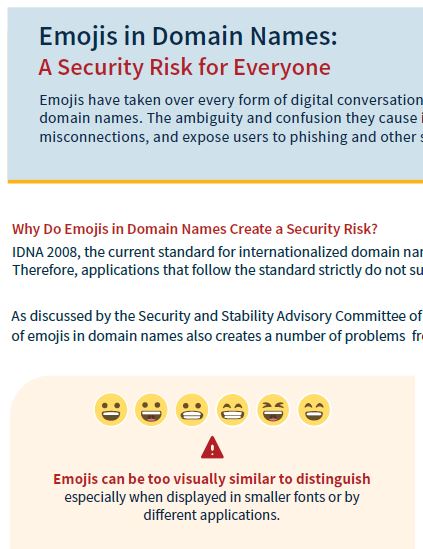
Download the "Emojis in Domain Names" document and learn why they create a security risk when used in domain names:
- العربية [PDF, 236 KB]
- 中文 [PDF, 185 KB]
- English [PDF, 140 KB]
- Français [PDF, 143 KB]
- Pусский [PDF, 162 KB]
- Español [PDF, 143 KB]
Visit our Resources section for useful links and related documents.